
A single QR code or link shouldn't need to know whether the person scanning it speaks English, French, Spanish, or Japanese — the routing behind it should.
That's the idea behind Adaptive Geo-Routing: the same QR code or link can send different customers to different destinations, based on language-region preference, country, device, operating system, app availability, and the routing rules you define. The destination can be a localized website, a regional retailer, a product page, or content inside an installed app.
No new QR code. No SDK. No website rebuild. If your campaign's destinations change six months from now, you change the routing — not the code printed on 500,000 boxes.
The QR code is permanent. The destination isn't.
Traditional QR campaigns tend to assume everybody who scans gets sent to the same place. Dynamic QR codes improved on that by letting marketers change the URL behind the code — useful, but still fundamentally one code, one active destination.
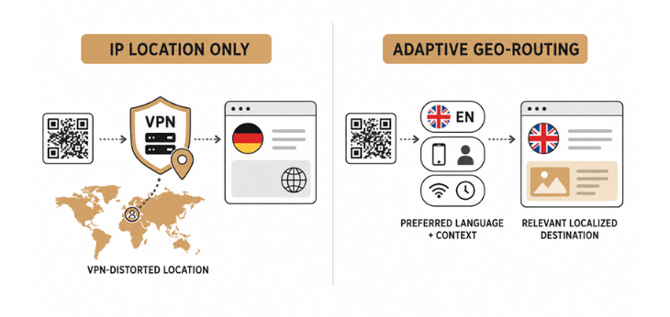
Adaptive routing changes the model. One QR code can sit in front of many destinations and decide which one makes sense for each scan. URLgenius evaluates the signals available for that request, compares them with the rules you've configured, and routes the customer accordingly. Campaign owners can also define fallbacks for when the preferred page, retailer, or app destination isn't available.
That makes the printed QR code something closer to permanent infrastructure — the intelligence lives in the routing behind it.
Watch a walkthrough of Adaptive QR Codes in action: How One QR Code Can Handle Multiple Countries and Languages
Country is a lousy proxy for language
Geo-routing has traditionally leaned heavily on IP location — useful, but not enough. Someone in Canada might want English or French. Two people standing next to each other in Miami may have completely different language preferences. And an English-speaking traveler in Germany probably doesn't want a German-language experience simply because a location lookup says "Germany."
VPNs complicate the picture even further, since an IP address can reflect the location of the VPN server rather than the customer's actual device.
URLgenius can consider language-region preference alongside country and other routing signals. That lets a brand distinguish between combinations such as English/U.S., Spanish/U.S., English/Canada, and French/Canada — and assign a different destination to each when the campaign calls for it.
The customer doesn't have to think about any of this. They scan. They arrive. That's the point.
Stop sending global customers to a country selector
Think about what happens after someone scans a QR code on a product package: they've already expressed intent. Sending that person to a global homepage and asking them to choose a country wastes that intent. Asking for a language adds another decision. Then perhaps they still have to find the right product or retailer.
If you already know the destinations you want customers in France, Canada, the UK, India, or the U.S. to reach, configure those rules once and let the routing handle the decision. A French-speaking customer in Canada can go to the French Canadian experience. A U.S. customer with Spanish as the preferred device language can go to the Spanish-language version. A customer with the right app installed can go directly to the app when the campaign calls for it.
One scan. Fewer decisions.
This isn't just for QR codes
A QR code is simply another way to open a URL. So the same adaptive routing can sit behind the URLs you use in social campaigns, creator content, email, paid media, connected TV, and other channels. That matters because localization shouldn't suddenly disappear when the customer taps instead of scans. The campaign can use the same routing strategy across both behaviors: identify the best configured destination, send the customer there, and maintain centralized control over the rules.
Printed something six months ago? Change it anyway.
Physical media sticks around. Packaging sits on shelves. Signs remain in stores. Event materials get reused. Print campaigns live much longer than anyone expects, and connected-TV creative can keep running while offers, landing pages, retailers, and regional campaigns change underneath it.
Adaptive routing lets the destination strategy evolve without replacing the QR code itself. Campaign owners can add markets, swap retailers, retire an offer, introduce another language, or change fallback rules after deployment. The physical asset stays put — everything behind it can move.
One global asset doesn't require one global destination
This opens up a much cleaner way to think about international campaigns. A brand doesn't necessarily need a U.S. QR code, a Canadian QR code, a French QR code, and a UK QR code printed across different versions of the same creative.
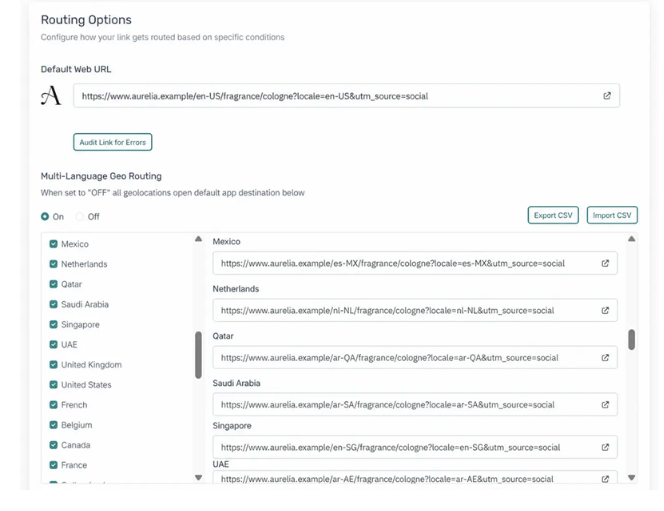
The same applies to packaging, retail displays, event signage, sponsorship materials, connected-TV creative, digital out-of-home, and print. The campaign asset can remain consistent while the customer experience changes by market or language. That simplifies operations, and it improves the experience at the exact moment someone has decided to engage.
You still get one view of performance
More destinations don't have to mean fragmented measurement. URLgenius keeps the routing layer centralized and can report on traffic across dimensions including source, destination, location, device type, and operating system. Attribution parameters can also continue into a brand's existing setup, without maintaining a completely separate QR-code strategy for every market.
When adaptive routing makes sense
You probably don't need adaptive geo-routing for a QR code on the menu of a neighborhood coffee shop. It's most useful when the same campaign can reach people across different countries or languages — particularly when:
- The campaign uses the same creative across multiple markets
- Customers currently land on a generic global homepage
- Customers must choose their own country or language
- Different markets use different retailers or storefronts
- The QR code will remain in circulation for months or years
- App and web destinations need to coexist
- Marketing needs to change routing without waiting on an engineering release
If several of those sound familiar, the question isn't really whether you need a "better QR code" — you need smarter routing behind the one you already have.
Frequently Asked Questions
Can one QR code send people to different URLs? Yes. A URLgenius QR code can route scans to different configured destinations based on campaign rules and signals such as language-region preference, country, device, operating system, and app availability.
Can I route by country? Absolutely. Country can be one of the inputs — it just doesn't have to be the only one.
Can I route by preferred language? Yes. Language-region preference can be considered alongside country and other available routing signals, which is useful in multilingual markets where geography alone doesn't tell you everything about the customer.
What's the difference between a dynamic QR code and an adaptive one? A dynamic QR code lets you change the destination. An adaptive QR code can choose among multiple configured destinations for each scan — that's the key difference.
Can destinations change after the printed code? Yes. Add a market, replace an offer, revise a routing rule, or update a fallback. The printed QR code stays the same.
Can the QR code open an app? Yes. Depending on the campaign configuration and what's available on the device, URLgenius can route into an installed app, to an app store, or to a web destination.
Does this work for regular campaign URLs too? Yes. The same routing logic used for QR codes can also be applied to URLs distributed through social media, email, creator campaigns, paid media, and other digital channels.
How many destinations can one QR code support? URLgenius supports an unlimited number of configured destinations behind a QR code, with campaign owners controlling the routing rules and fallbacks.
Do we need an SDK? No. URLgenius adaptive geo-routing does not require an SDK, app release, or changes to the brand's website.